

Blog
25 September 2026
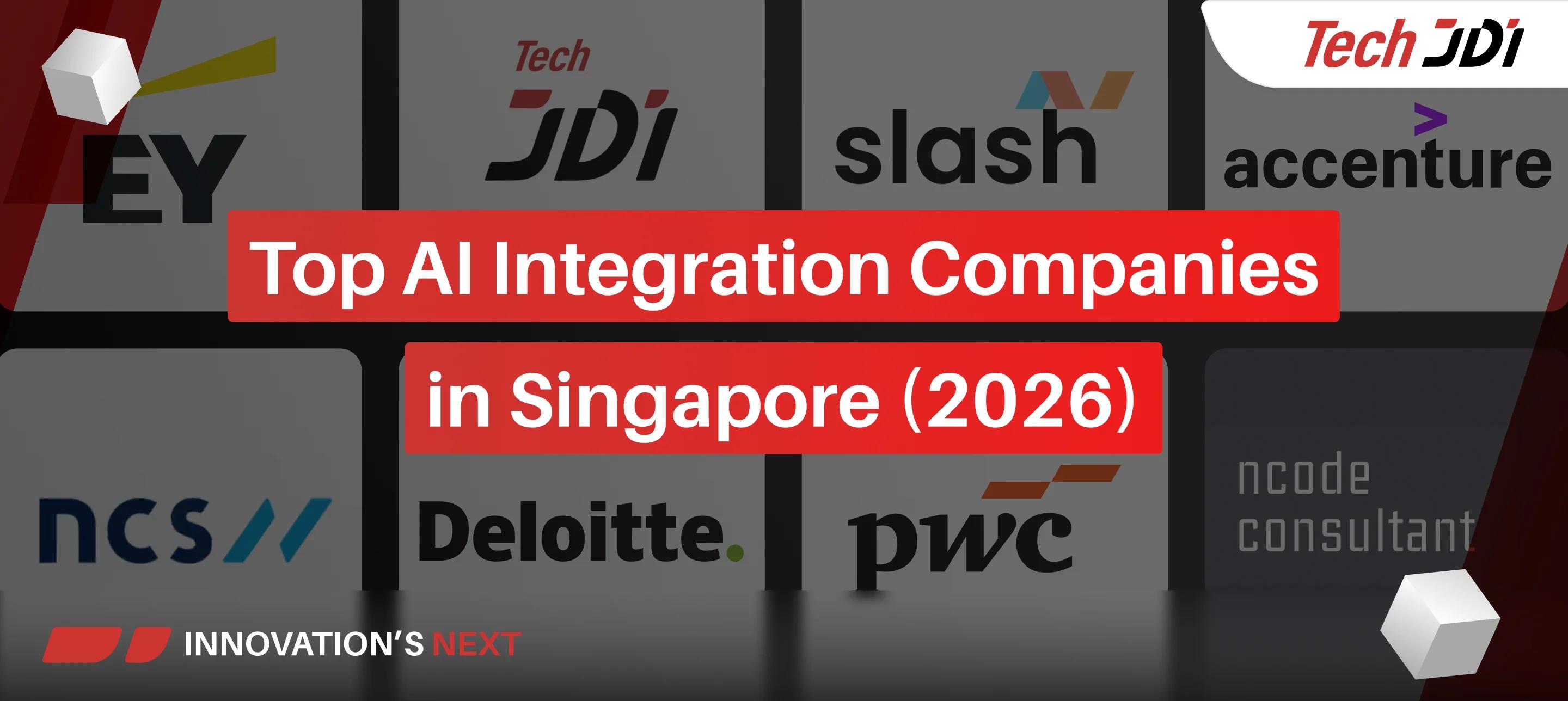
Top AI Companies in Singapore (2026)
Looking for AI companies in Singapore to help your business build, integrate, or modernise its systems with AI? Then this article is for you.
Over the past couple of months, we have reviewed nearly a hundred leading AI vendors, looking closely at their specialties, capabilities, and the solutions they offer, from custom AI development and implementation to ready-made AI platforms and ecosystem integration.
We narrowed the list down based on their areas of expertise, technology capabilities, range of services, and the types of business needs they can support. The result is a selection of Singapore AI companies worth considering if you’re looking to build a custom AI solution, integrate AI into an existing system, or bring AI into your day-to-day operations.
Understanding the Different Types of AI Companies in Singapore
AI companies can mean very different things. Some build the underlying AI technology, while others use that technology to solve specific business problems.
In simple terms, you can broadly divide the market into two main groups:
- AI Builders that develop the underlying AI models, platforms, and infrastructure.
- AI Solution Companies that use those technologies to build AI solutions for specific business needs.
1. AI Builders: The Technology Behind AI
AI builders develop the technology that powers many of the AI solutions businesses use today. Their products can include foundation models, AI platforms, cloud infrastructure, AI development tools, and computing technology.
For businesses, these technologies provide the underlying capabilities needed to build, deploy, and integrate AI into their products and operations. Currently, there are five major AI ecosystems relevant to Singapore businesses, including:
Company | What It Builds For Business | Singapore Footprint | How Businesses Use It |
Microsoft | Microsoft 365 Copilot, Microsoft Copilot Studio, Agent 365 | Committed USD 5.5 billion to cloud and AI infrastructure and operations in Singapore for 2025–2029 (Microsoft, 1 April 2026) | Copilots and agents inside the Microsoft tools a company already uses |
Google Cloud | Gemini Enterprise and Gemini Enterprise Agent Platform | Singapore cloud region open since June 2017 (Google Cloud) | Agents connected to company data and Google Workspace |
AWS | Amazon Quick-Suite and cloud infrastructure | Asia Pacific (Singapore) region, announced April 2010 (AWS) | AI applied to business data already held on AWS |
OpenAI | Frontier AI models, ChatGPT Enterprise, the API platform | “OpenAI for Singapore”, a commitment of more than SGD 300 million that includes its first Applied AI Lab outside the US (OpenAI, 19 May 2026) | Models that power other applications, often reached through Microsoft |
NVIDIA | Computing hardware and NVIDIA AI Enterprise software | Singapore office; a Singapore research hub announced in May 2026 (Mothership, 20 May 2026) | The hardware layer underneath AI, rarely bought directly by mid-sized companies |
For most businesses, however, choosing an AI builder is only part of the equation. The bigger question is how to turn these technologies into something useful for the business.
2. AI Solution Companies: Turning AI Into Business Applications
This is where AI solution companies come in. They take existing AI technologies and apply them to a specific business problem, workflow, product, or industry use case.
Instead of building the underlying AI model, they use platforms and models from companies such as Microsoft, Google, AWS, or OpenAI to create a solution around the client's requirements.
For example, a business might want to:
- Add an AI assistant to its internal systems
- Automate repetitive customer service tasks
- Search and analyse information across company documents
- Add AI-powered recommendations to an existing product
- Connect AI agents to CRM, ERP, or other business systems
Providers of AI solutions in Singapore can generally be divided into two further groups:
AI Product Companies | AI product companies, often called AI software companies, sell ready-made software with AI built in to solve a defined business problem, function, industry use case, or workflow. It may offer integrations with other systems, but the core product remains controlled and developed by the vendor. |
AI Integration Companies | AI integration companies connect AI capabilities to the systems, data, and workflows a business already runs to design, build, connect, and deploy a solution around the business requirement.
In practice, the work usually covers four areas:
1. Choosing the right platform for the job, often starting with the platform the client already uses. 2. Connecting AI to the systems the business already relies on. 3. Preparing data and handling security and PDPA requirements. 4. Supporting and maintaining the system after it goes live. |
Interested in AI Integration?
|

AI Builders, AI Product Companies, and AI Integration Partners Comparison
| AI Builder Companies | AI Product Companies | AI Integration Companies |
What do they provide? | AI models, platforms, infrastructure, or developer tools | A finished AI-enabled product designed for a specific problem, function, or workflow | A working system built on an AI platform |
Where does the work happen? | Primarily within the provider’s platform, APIs, or products | Primarily within the provider’s product, with integrations where supported | Across the customer’s technology environment, systems, data, and workflows |
Who do you deal with? | The platform provider, a reseller, or a self-service platform | The product vendor’s sales, implementation, and support teams | A project team responsible for implementation and integration |
What do you pay for? | Typically usage, subscription, or licence fees, depending on the platform | Typically a subscription, licence, or usage-based fee | Typically project fees, potentially with ongoing support or maintenance fees |
Who supports it after launch? | The platform provider, but not your specific configuration | The vendor, for its own product | The project team, for the integrated system |
What do you own at the end? | Generally, the right to use the provider’s platform or services under its terms | Generally, the right to use the product under its licence or subscription terms | The configuration and workflows, plus the code, prompts, and other deliverables depend on the contract |
Choose it when | You have in-house technical staff who will build on the platform themselves | Your problem is common to your industry, and a ready-made product fits your process | AI must work with the systems, data, and approval steps you already have |
Top AI Companies in Singapore for Development and Integration 2026
For this list, we focus on AI companies in Singapore that help businesses design, develop, implement, and integrate AI into their operations.
Rather than standalone AI products, the comparison focuses on solution-based services tailored to specific business needs, workflows, and existing systems, providing a quick overview of what each company offers.
Company | Category | AI solutions they provide | Best suited for |
Tech JDI | AI integration company | AI consulting, custom AI development and system integration | Non-tech companies that need AI applied to specific business problems or connected to existing systems |
NCODE Consultant | AI integration company | Custom software, AI automation, machine learning, computer vision and chatbots | Singapore SMEs and corporations wanting AI added to operational systems |
NCS | AI integration company | Enterprise AI, AI data engineering and platforms, AI-native application development | Government agencies and large enterprises running major technology programmes |
Slash | AI integration company | Custom software, generative AI prototyping and intelligent automation | Companies and funded startups building a new AI product or platform |
Accenture | AI integration company | AI & data, systems integration, intelligent automation and AI agent development | Large enterprises and government agencies running enterprise-wide AI programmes |
Deloitte | AI integration company | AI consulting, engineering, agentic AI, systems integration and AI governance | Large enterprises and regulated organisations pairing agent deployment with governance work |
PwC | AI integration company | AI solution development, enterprise AI implementation, AI agents and responsible AI | Financial services, government and large corporates with regulatory requirements |
EY | AI integration company | AI consulting, agentic AI, intelligent automation, data and AI implementation | Enterprises in regulated industries that need audit, risk and governance alongside AI |
Even among the best artificial intelligence companies, the right choice depends less on which company has the most AI capabilities and more on what you actually need to accomplish.
If you have a specific business problem and need AI connected to your existing software, data, and workflows, an AI integration company may be the more relevant option. You get help choosing the right technology, designing the solution, integrating it with your existing systems, and supporting it after launch.
If your need is already well defined and a ready-made product exists, an AI product company may be more practical. You can adopt an existing solution rather than invest in building and maintaining your own.
Below, we will deep dive into each mentioned AI company and their strengths and why you should choose them.
Tech JDI

Overview
Founded in 2016, Tech JDI is a Singapore-based software development and AI implementation company serving businesses across Asia and beyond. The company helps businesses modernise existing systems, build new software, and put AI to work through practical, scalable solutions that make processes smarter and more efficient.
- Core Services: Custom Software Development · Application Modernisation · Systems Integration · Data & Cloud Engineering · Dedicated Development Teams · AI Solutions & Agent Implementation
- Key Strength: As a partner of AWS, Microsoft, and Google Cloud, with ISO/IEC 27001-certified security practices and teams in Singapore and Vietnam, Tech JDI combines strong technical capabilities with efficient delivery and competitive development costs.
- Delivery Model: Scoped project delivery with ongoing support, alongside dedicated development teams and Build-Operate-Transfer options for businesses looking to build their own long-term technical capability.
- Best Suited For: Enterprises, startups, and especially mid-sized and non-tech businesses looking to turn modernise or add AI capabilities to existing business software and operational systems.
→ View the case study: How Tech JDI Integrated AI Into an Existing Healthcare Platform

NCODE Consultant

Overview
NCODE Consultant is one of the AI companies in Singapore, providing software development and IT consultancy services to SMEs, corporations, and government-linked organisations. Its work spans business software, ERP, e-commerce, retail, manufacturing, and AI-enabled systems.
- Software Development Capabilities / Core Services: Web & Mobile Application Development · Enterprise Systems · AI Enablement · Systems Modernisation · Data & Architecture
- Key Strength: NCODE brings extensive experience in business software and enterprise systems, particularly for SMEs and larger operational environments.
- Delivery model: Custom project work quoted per brief.
- Best suited for: Singapore SMEs, corporations, and government-linked organisations.
NCS

Overview
NCS is one of the leading AI companies in Singapore, serving governments and enterprises across Asia Pacific. Its focus spans AI, cloud, applications, engineering, cybersecurity and digital infrastructure.
- Software Development Capabilities / Core Services: Application Services · Digital Solutions · Cloud & Data · Platforms · Engineering · Cybersecurity
- Key Strength: Enterprise-scale delivery combined with a broad technology ecosystem.
- Delivery model: Large, multi-year programmes delivered by in-house teams. Pricing is contract-specific and not published.
- Best suited for: Government agencies and large enterprises running multi-year technology programmes rather than a single AI use case.
Slash

Overview
Slash is a Singapore-based venture studio and technology company that builds digital products and AI solutions for corporates, startups, SMEs and government organisations.
- Software Development Capabilities / Core Services: Generative AI · Web & Mobile Development · Backend Development · Product Design · Software Engineering · Deployment
- Key Strength: Rapid product development and prototyping, with an AWS partnership supporting cloud architecture and delivery.
- Delivery model: Custom project delivery, including a three-week prototyping model.
- Best suited for: Companies, startups and organisations looking to build or prototype a new AI-enabled product rather than primarily add AI to existing operational systems.
Accenture

Overview
Founded in 1989 and listed on the New York Stock Exchange, Accenture is a global professional services company serving about 9,000 clients and one of the largest AI implementation businesses in the market.
- Software Development Capabilities / Core Services: AI & Data · Systems Integration · Intelligent Automation · AI Agent Development · Cloud & Data Engineering
- Key Strength: Scale and its AI Refinery platform, which supports the development and deployment of networks of AI agents, backed by dedicated business groups with NVIDIA and Anthropic.
- Delivery model: Large, multi-year programmes delivered through a global network of advanced technology centres, with a separate Accenture Edge unit launched in June 2026 for mid-market companies.
- Best suited for: Large enterprises and government agencies running enterprise-wide AI programmes with the internal capacity to absorb them.
Deloitte

Overview
Founded in 1845 and structured as a network of member firms across more than 150 countries, Deloitte is a global professional services company with extensive AI consulting, engineering, and implementation capabilities across Southeast Asia.
- Software Development Capabilities / Core Services: Technology Consulting · Engineering, AI & Data · Agentic AI · Systems Integration · Risk & AI Governance · Audit, Tax and Advisory
- Key Strength: Combines industry consulting with technical delivery, backed by 120+ AI specialists and 6,000+ practitioners across Asia Pacific.
- Delivery model: Engagements contracted with the local member firm and delivered by in-house teams, including forward-deployed engineers embedded with client teams.
- Best suited for: Large enterprises and regulated organisations that want agent deployment paired with governance, risk and assurance work.
PwC

Overview
PwC Singapore operates an AI Hub and AI Factory in Singapore focused on developing, implementing, and scaling AI solutions for businesses. Its current offering includes enterprise tool rollouts, AI solution development, responsible AI implementation and ongoing deployment support.
- Software Development Capabilities / Core Services: Technology Consulting · Cloud Engineering · Data & AI · AI Agent Development · Cybersecurity, Risk & Regulatory · Audit, Tax and Deals
- Key Strength: A local AI team with a strong Singapore presence, supported by PwC’s agent orchestration platform, which runs across major cloud and on-premises environments, and an expanded Anthropic alliance announced in May 2026.
- Delivery model: Structured programmes covering use-case identification, prioritisation, development, MVP deployment, scaling and ongoing support.
- Best suited for: •Financial services, government and large corporates that need AI work delivered alongside risk, regulatory and assurance requirements.
EY

Overview
EY Singapore provides AI consulting and implementation services covering strategy, architecture, data, systems integration, programme operations and risk. As one of the leading AI companies in Singapore, its Singapore Agentic AI Center of Excellence also develops and deploys enterprise AI agents and integrates them with existing IT environments.
- Software Development Capabilities / Core Services: Technology Consulting · Data & AI · Agentic AI · Intelligent Automation · Responsible AI & Assurance
- Key Strength: Governance and assurance depth alongside implementation, was named NVIDIA’s GSI Tech Innovation Partner of the Year for 2026.
- Delivery model: Consulting engagements contracted through the local member firm, with delivery supported by EY’s own AI platforms and managed services.
- Best suited for: Enterprises in regulated industries that need AI adoption to satisfy audit, risk and governance requirements as well as business goals.
How To Know Your Business Is Ready For AI
Before choosing one of the AI companies in Singapore, first determine whether your business has a problem that AI can realistically solve.
AI readiness is not about how advanced your company is. It comes down to whether you have a clear use case, usable data, a workable process, and the systems and people needed to put AI into production. A practical AI readiness check starts with six questions:

1. Is There a Clear Business Problem?
Start with the problem, not the technology.
Look for work that is:
- Repetitive and time-consuming
- Dependent on large volumes of information
- Slowed down by manual review or decision-making
- Difficult to scale as the business grows
- Prone to errors or inconsistent results
- Dependent on employees searching across multiple systems
- Creating delays for customers or internal teams
A vague goal such as “we want to use AI” is not enough. You should be able to describe what needs to improve and why it matters to the business.
2. Is the Process Well Defined?
AI works best when there is a clear workflow to improve.
Map how the work happens today:
Input → Process → Decision → Action → Outcome
Identify who does the work, what information they use, which systems are involved, where decisions are made, and where delays or manual steps occur.
If the process itself is constantly changing or poorly understood, it may be too early to automate it with AI.
3. Do You Have the Right Data?
AI needs access to relevant information to produce useful results.
Check whether the data required for the use case is:
- Available
- Relevant to the task
- Accurate enough to use
- Stored in accessible systems
- Structured or searchable where necessary
- Governed with appropriate access controls
For example, an AI assistant for customer service may need access to product information, policies, customer records, and previous interactions. If that information is scattered, outdated, or inaccessible, the challenge may be data readiness rather than AI itself.
4. Can AI Actually Improve the Work?
Not every business problem needs AI.
Consider whether the task requires capabilities such as:
- Understanding natural language
- Searching and summarising large amounts of information
- Extracting information from documents
- Generating content or responses
- Classifying or analysing unstructured data
- Making recommendations based on patterns
- Taking actions across multiple business systems
For straightforward rules-based processes, traditional automation may be simpler and more reliable.
The question is not “Where can we add AI?” but “Where does AI provide a capability that improves the current way of working?”
5. Can the AI Fit Into Your Existing Systems?
A promising AI use case still needs to work within your technology environment.
Check:
- Which systems the AI needs to connect to
- Whether APIs or other integration methods are available
- Where the required data is stored
- How users will access the AI
- What permissions and security controls are required
- Whether the solution can work with your existing cloud and software environment
For example, an AI sales assistant may need to work with your CRM, email, calendar, documents, and reporting tools. Building the AI is only part of the implementation. Connecting it to the systems where work already happens is often just as important.
6. Can You Measure the Value and Manage the Risk?
Before starting a project, define what success looks like.
Depending on the use case, useful measures could include:
- Hours of manual work reduced
- Faster response or processing times
- Fewer errors or rework
- Higher conversion or completion rates
- Reduced operating costs
- Better access to information
- Improved customer response times
You should also consider the risks involved, particularly when AI handles sensitive data or influences important decisions. Review data privacy, security, access controls, human oversight, accuracy requirements, and regulatory obligations before deployment.
The goal is not to adopt AI for its own sake. A business is ready for AI when it has a clear problem worth solving, a process that can be improved, the data and systems needed to support the solution, and a way to measure whether it works.
Not Sure Where AI Fits in Your Business? Let’s Find Out with Tech JDI’s AI Readiness Checklist or Book a Free 1-Hour Call with Our Experts

How to Choose the Right AI Company for Your Project
Once you have identified a viable AI use case, the next step is finding an AI partner that can actually deliver it.
AI companies in Singapore can differ significantly in what they do. Some provide AI platforms or products, while others focus on consulting, integration, custom development, or implementation. The right choice depends on what your project requires.
Rather than choosing based on a long list of technologies or partnerships, ask questions that reveal how the company approaches your specific problem.
Criteria | The question to ask | A good answer sounds like |
AI capability | Can you build AI agents, automation and chatbots, not only advise on them? | Specific examples of each, with the platform used |
Integration | Can you connect AI to our existing software, data and workflows? | Named system types — CRM, helpdesk, ERP — and how access is handled |
Custom development | Can you build around our specific process? | Questions about your process before any proposal |
Ecosystem partnerships | Do you work with Microsoft, AWS or Google Cloud as a partner, and can you describe a live project on that platform? | The partnership named plainly, and one delivered project explained |
Industry experience | Have you worked with businesses like ours? | Relevant use cases, described without naming clients who have not agreed to it |
Security and PDPA | How do you handle personal data, access, and the PDPA? | Where data is stored, who can access it, and a written data processing agreement |
Proof of work | What evidence can you share? | Case studies, reviews or references, with sources you can check |
Pricing Model | How is the work priced — fixed scope, time and materials, or a retainer — and what is charged separately? | A written scope, the pricing model named, and support priced as its own line |
Project Timeline | How long will this take, and what are the milestones between kick-off and production? | A phased plan, the dependencies on your side named, and what happens if data preparation runs long |
Ownership and exit | Who owns the code, prompts, and configuration when the engagement ends, and what does handover cost? | Ownership assigned to you in writing, and a defined handover package |
Not every question will apply to every project. A simple internal AI assistant, for example, will have different requirements from a customer-facing AI application connected to sensitive business data.
The goal is to find an AI partner whose capabilities, delivery approach, technology experience, and way of working match the requirements of your project. A clear understanding of those requirements makes it easier to compare AI vendors, define scope, and avoid surprises later.
→ For more insights, you can also see how other Singapore providers describe their work in our guide to AI software development companies, and what changes when delivery sits offshore in our guide to outsourcing AI development. |
Still Not Sure Where to Put AI to Work in Your Business?
Choosing between AI companies in Singapore gets easier once you know which type of company your project needs.
If you are still assessing where AI could fit within your business, the next step is to discuss your existing workflows and potential opportunities with a technical team.
Book a Free 1-Hour Discovery Call to explore where and how AI could deliver practical value in your business.

Frequently Asked Questions
How much does AI implementation cost in Singapore?
The main cost drivers are the number of systems involved, data readiness, workflow complexity, and ongoing support. Platform licences are separate and are usually charged per user or based on usage by Microsoft, Google, or AWS.
→ See more insights: AI Development Cost Breakdown in 2026
How long does an AI integration project take?
The timeline depends on the number of systems involved, data readiness, workflow complexity, and the level of customisation required. Projects that involve multiple systems, complex data, or extensive testing and approval processes typically require more time to implement.
Which platform should we build our AI agents on?
It depends on where your data and daily work already live. We compare AWS, Microsoft, and Google Cloud options and recommend the platform that best fits your systems, security requirements, and budget.
Does PDPA apply to the data an AI system uses?
Yes. Personal data used by an AI system is covered by the PDPA. The PDPC’s Advisory Guidelines on Use of Personal Data in AI Recommendation and Decision Systems (1 March 2024) and its guidelines on generative AI (20 July 2026) set out consent, notification and accountability expectations for businesses deploying AI.
Which AI platform should my business use?
There is no single platform that suits every business. The decision should consider where your data and daily work already sit, existing technology investments, security requirements, integration needs, and the type of AI solution you want to implement.


Customized AI Solution Case Studies Tailored by Tech JDI
Explore now

Transform Your Vision into Reality with Our Customized AI Solution!
Learn more